Jeff Meredith - 2023 Reflection & 2024 Anticipation
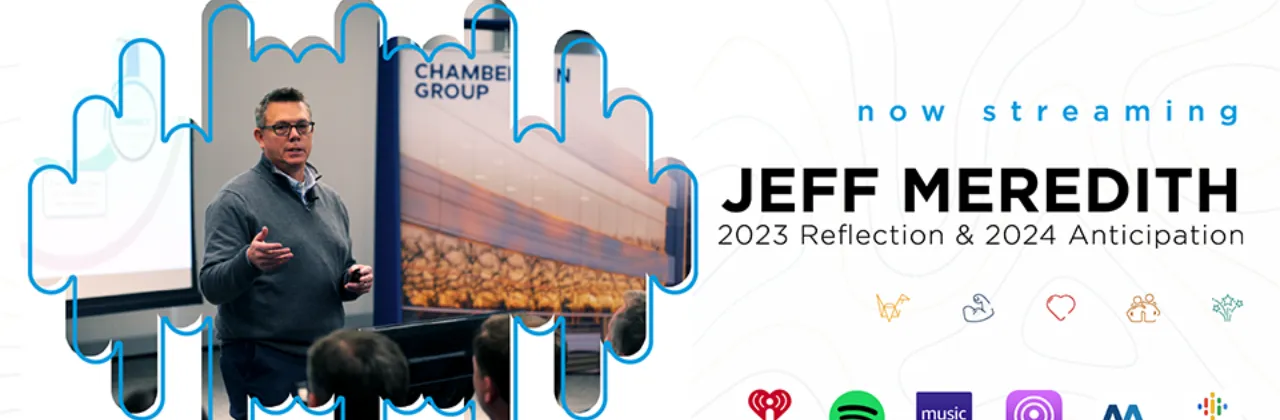
CEO Jeff Meredith joins the Connected Podcast once again to wrap up the year & reflect on what worked, what inspired him, what challenged him, and what Chamberlain Group will strive to accomplish in the coming year.
Transcript
Colin Uthe:
Welcome to Connected, a podcast about the operations and the people that make up Chamberlain Group. At the end of his first full year as Chief Executive Officer in 2022, Jeff Meredith spoke with me about his experience so far at the helm of Chamberlain Group. He reflected on his development as a leader and what we had accomplished that year in order to take an even larger leap the following year towards our transformation as a global leader in intelligent access.
At the end of our discussion, Jeff told me our top organizational goals that would drive our strategy in 2023, as well as how those goals would be set and tracked. As we catch our breath in between the year-end holidays, Jeff and I met again to discuss how we did in those goals and what's to come in 2024.
Jeff, thank you so much again for sitting down and talking with me for a little bit.
Jeff Meredith:
Yeah, it's good to be here with you again, Colin. When you first told me you were going to do the podcast, I wasn't sure if it would be well received by the organization or something that was listened to with frequency, and I've been really pleased over the course of the year that it's been become an impactful communication tool for our organization. And so it's a pleasure to sit down again and do a year-end recap.
Colin Uthe:
Oh, thanks. Podcasts are hot right now.
Jeff Meredith:
Yeah.
Colin Uthe:
Everybody's got a podcast. Last year when both of us spoke, you said that one of your biggest personal wishes as CEO was to remain Jeff. How do you feel about that another year into it?
Jeff Meredith:
I think that for the most part, I've done that this year. I think as a leader, authenticity is paramount and if you try to put on airs and act like somebody that you're not, it shines through pretty readily for the organization to see. So I feel like that I've made some good strides just to maintain authenticity as a leader. Sometimes that's good, people see me as a real person and somebody that has emotions and passion, and sometimes my emotions and passion maybe get the best of me a little bit.
Colin Uthe:
Boils down to personal preference. Yeah.
Jeff Meredith:
But I'd rather be real and show my true self than try to act like somebody that I'm not. So I think at my core, I care deeply about this organization. I care about the people in the organization. It doesn't mean that I don't have to make tough calls and tough decisions from time to time for the better of the overall organization. But I think if you behave in an authentic fashion consistently, people know that your motivations are consistent and they understand rationale for decisions.
Colin Uthe:
Definitely. Have you noticed your character develop at all in the last year on top developing onto any of those traits that you mentioned to me?
Jeff Meredith:
Yeah, I think that I'm definitely still trying to learn as a leader and figure out how to move a company through this transformation that we're on, and there are dimensions of my leadership that I think I've really honed in on in 2023. I've tried to do more coaching and instructing. A lot of the things that we're trying to do we've never done before, and in some cases nobody's done before as a company. And so to demand that people actually achieve things that none of us really know how to do is not an effective leadership style. So more coaching, more come up to the table and work collaboratively to try to get through difficult decisions or come up with the right tactical plans. So spend more time coaching, make sure that there is a lot of time spent in painting the picture of where we're going so that there's motivation around that.
So I've tried to do that quite frequently, not just assume it's well understood, but to make sure that the people in the organization see where we're trying to get to because someday when you're mired in the difficulties of the day, you may lose perspective of we want to be this company that's about intelligent access that is one of the only companies ever that's moved into a position where we're not just selling industrial hardware, but we've come on top of that and built an ecosystem that really provides value to our customers. So I think this idea of not just getting stuck in the challenges of the day, but making sure that we lift our heads and see out. And I think also just making sure that we don't miss what we've already accomplished.
There's a couple of smart home apps out there that have 10 million users, Nest and Ring. We're the third. It's pretty compelling, and I think sometimes as we progress through our task and through our accomplishments trying to achieve what we want to this year, we miss that we've actually already done quite a bit. We've got 7 million homes in the US that use our app on a regular basis. Our share positions across both residential and commercial are extremely solid, and our products are viewed as by far the most reliable in the market. And so we've got a lot to hang our hat on as a company. So making sure that there's appropriate measure of let's push to achieve and transform, but that's also not miss not only what we've accomplished, but what we're trying to accomplish as we go forward.
Colin Uthe:
I want to talk about what happened around the world as far as Chamberlain goes. We, first in the year, when did this happen? Probably in the summertime we expanded our engineering team out to India with the official establishment.
Jeff Meredith:
Yeah. Actually it was in the September timeframe.
Colin Uthe:
September.
Jeff Meredith:
We did that, and it was an important step for us. So one of the things that as we become a more global company, and we've made some changes in Europe that I'm really proud of, and we've brought Kate Rose in to run that organization in Europe and reset a more ambitious growth target for where we want to go in Europe, but on the engineering side to expand our footprint into India, to couple with the resources that we have in Eastern Europe as well as engineering resources that we have in Nogales, as well as very strong engineering team here in the US. It just gives us a broader base to pull from. I've actually, in my career, I've had multiple engineering teams based in India, and it enables you to tap into the really strong talent that exists in Europe, particularly on the IT software development side.
It also helps us to, when you have people in different time zones, you can pick up work and continue work and then pick it up again in different time zone when it comes about. So to maintain this continuity from a work perspective almost in an around the clock fashion because of the time zone variations, that's something that's important. So I'm excited about where we're going. I mean, we started with this relatively small base in India, but we want to continue to expand that over the next several years and make sure that we are really kind of best in class from a software development standpoint, not only in terms of the resources that we have here in the US, but also outside of the US.
Colin Uthe:
In addition to opening our engineering center in Pune, I wanted to talk about maybe not so much as a establishment, but a celebration of a worldwide workforce with celebrating our 50th anniversary being in Nogales.
Jeff Meredith:
Yeah, no, honestly, that was a real highlight of my year spending the time in Nogales for the 50th anniversary. I just generally love going to Nogales every time that I'm able to go there because of the passion of the people, the real kind of love affair between the people of Nogales and the Chamberlain Group. And it's a long-lasting relationship, as you pointed out, and one that we're extremely proud of and something that the Duchossois family started 50 years ago in terms of the build out of the facility there. But it's been cultivated and grown over that 50 year period. I'm proud of the fact that we're the employer of choice. I got to spend some time with the mayor of Nogales, a former employee of Chamberlain Group.
Colin Uthe:
Are you serious?
Jeff Meredith:
Somebody that's really strong. Yeah.
Colin Uthe:
Oh, wow.
Jeff Meredith:
Somebody that's really strong advocate for our company went on the news at our 50th anniversary and announced that we were the best company in Nogales, which I love that.
Colin Uthe:
Some high praise.
Jeff Meredith:
Yeah. So we were able to celebrate some employees that had three generations on site there from a parent to a child, an adult child that was also still working there to a child that was using our daycare facilities on site right there for our employees. So yeah, the passion is just infectious whenever I go to Nogales and the commitment to excellence from a safety standpoint is top-notch and it's really the lifeblood of our company. And so to celebrate that event down there, just a lot of fun.
Colin Uthe:
Could you pick out part of the plant's culture that the rest of the world within Chamberlain Group could learn from?
Jeff Meredith:
For me, there is an unbelievable passion to give everything that you have to make the best product that we can possibly make and I think this is something that culturally has been there for a lot of years. There's this connection with the company that is very meaningful to the employees there. And really when you feel it, when you go there, you really feel it. And I wish that I could pour some of that in a jar and bring it all over the rest of the company and help others to feel the same passion. And that's one of the things as a leader that I'm really trying to do is to help people feel a connection to our company, understand what we're trying to do, feel like they have a critical role in what we're trying to do, understand their personal role in what we're trying to do, and feel a sense of meaning and critical nature to that role that they play. But it really is palpable and tangible for the employees in Nogales, this passion that they feel for our company.
So if I reflect on why we implemented OKRs, it's important to reflect on the logic that we use to actually deploy OKRs in the first place. OKRs are really broken down in O and KR objective, key result. Objective is an overarching goal that you've set it for yourself that is a guiding principle that helps prioritize. It could be that I want to move my monthly myQ connections from 250k to 350k. So the key results are what are the things that we're going to need to be able to do to do that? What are the results that we're going to have to see to ensure that we move that myQ connections rate up a hundred thousand per month? We want to execute the "Just Download the App" campaign, and we want that to yield an incremental 50 to 70,000 connections per month. We want to deploy the AI driven setup flow where you actually, we shared this at the last all company meeting where you walk around the GDO and it tells you, oh, you have one of these. Here's what you need to do to connect.
Colin Uthe:
Yeah, we actually just talked about that on one of these as well.
Jeff Meredith:
Yeah, so that could be another KR. There could be multiple. So if I need 100k over here on the objective, I need four things that yield at 50 and 20 and 20 and 10 to get me the 100k. So these are the tactical dimensions that drive to the objective.
We have a critical need to prioritize as an organization right now to focus on the things that matter most. And we also have a critical need to align across functions. A few things that I've observed in my time here is that we really try to do it all as opposed to, say, of these 10 things, these two really matter the most and these eight matter less, and I'm going to really dial in on those two things.
We also have historically worked in a more siloed fashion than I'd like us to. Our number one is the function that we're in, not the company overall.
Colin Uthe:
Maybe at a different time it worked for us better.
Jeff Meredith:
Yeah. I think when we weren't trying to change things and we're just maintaining status quo, you can work at a functional level a lot easier than when you're trying to, because very rare is a change only driven at a functional level, a change, especially the change that we're trying to drive with the transformation of the company works across all functions. And so if it's not well understood and aligned across the whole of the company, then you start to get a lot of friction. So for me, the goal with OKRs was twofold, one, drive prioritization, two, align across the organization.
Colin Uthe:
I wanted to talk about the one OKR that stuck out a little bit just because it's not totally connected to service revenue, it's engaging our employee base.
Jeff Meredith:
This to me, it stems back to what we just talked about relative to the Nogales employee base. And if I could kind of pick one thing up and put it into the broader company, what would I do? And it really is that of engaging our employees in what we're trying to do and have them be inspired by the uniqueness of what we're trying to achieve as a company and help it to become personal. And so for me, you can engage employees in a lot of extracurricular things, which we're trying to do through BRGs. We're trying to do through different events and just fun things that we do around the office, which I think is important. But I think if it's just that and you're not engaged in what we're trying to accomplish as a business, that's a bit shallow, right? A bit shallow. I think what really drives engagement of your employee base is they feel like the work that they're doing every day is important and meaningful, and we're trying to do something really cool as a company and they're critical dimension of it.
So part of what, and you hit on this earlier, Colin, in that as a leader, I'm trying to find ways to help people see there's 10 million users of our app, 10 million users of our app that are counting on us, customers that rely on us to move in and out of their lives every day in a seamless fashion. So it's important. It's important to them, it's important to us also making sure that our employees feel deeply engaged in the vision and mission of our company and their role in making that happen is also critical. And I think if you don't have both, I don't think employees will be as motivated and inspired to do their absolute best. There's a lot of other things that go with it. People need to feel like they're appreciated. They need to have career advancement opportunities. They need to feel like their voice actually is heard and there's action taken on things that are really good suggestions. All of those things are important. And I feel like that I've dedicated and with the HR team and Gina, a lot of focus on that this year.
But ultimately, I really want people, everybody in the company to feel like they're part of this transformation of the company and they're part of this future vision of where we're trying to get to. And I've encouraged people to, if they don't feel like they are, then go talk to their manager, go talk to their manager's manager. If they feel like they're just doing a mundane task and they're not part of what we're ultimately trying to do, it's imperative that we get everybody to have a sense-
Colin Uthe:
That autonomy.
Jeff Meredith:
Yeah, have a sense that they are critical to it because the view that I have.
When you're going through a transformation as a company, it's not going to be a status quo type of environment. You're going to push hard to try to move into new areas to try to grow. You're going to make changes. It's not going to be one that every day is constant to the previous day. And we're going to identify opportunities and we're going to pursue those opportunities. And so I think for some people, an environment that has a change to it and lack of kind of day-to-day consistency is not necessarily comforting. And I want people to realize that that is kind of the direction that we're going to be over the next few years because we're trying to grow rapidly, we're trying to transform, and we're not in a status quo environment. So I think for people to feel more comfortable with that and to actually embrace that and learn to thrive within that is important.
I believe that in terms of achievement of success through OKRs to get there, it didn't happen in the way that I envisioned this year, and as a result, I want to step back, do an assessment and progress forward. Some of the things that I think that we need to change is we tried to put almost everything that people were working on in the form of an OKR; too much. OKRs should be the one most important priority. So for me this year, I want to move to one max two OKRs. I think our timing was too far-reaching. A lot of us set me included annual goals. I think we need to set at the far end quarterly goals and maybe even monthly goals. So one or two objectives, hopefully one. I'm going to set one for myself by quarter and then alignment across just the folks that are working on.
So if you're working on expansion of the video subscription rate, there is some marketing people, some engineering people, some connected services team, product leaders, but there's a group of people that are focused on expanding our video subscription rate. Doesn't mean that everybody in the company who touches that has that for an OKR, but the people whose primary responsibility to move the video subscription rate do have that as an OKR. And they have that, not four other things, but they have that.
So as we move on close out this year into 2024, I'll talk about the things that we need to revamp relative to OKRs and how we want to deploy them because I think the underlying need of prioritization and alignment still exists. The deployment of OKRs didn't really address it in the way that I wanted us to, but it's not uncommon. If you look at Google, it took four years for them to get it right. If you look at Intel, it took them five plus years before it really took traction so it's not surprising to me. Each company has to... it's not just a rollout of a formulaic approach. Every company has its history, its baggage.
Colin Uthe:
You got to tailor it.
Jeff Meredith:
And it needs to be adapted. And I think this is a kind of a microcosm for the broader company transformation that we're on. Everything that we try isn't going to work in its first pass, and we have to have the will, the perseverance, frankly, the intellect and the critical thinking to go back and assess what worked, what didn't work, and make adaptations on the fly. So that's where we are with OKRs.
Colin Uthe:
What did Chamberlain Group accomplish this year that you're most proud of?
Jeff Meredith:
So if I think about our accomplishments this year, there was a lot of things that we achieved that I'm super proud of. Crossing 10 million from a myQ app perspective is a huge accomplishment. But I think there's an area that I'm super proud of the organization because not only did we achieve this year, but we also have shifted mindset, and that's what we've done from a productivity standpoint. I'm encouraged by so many things in the company, but that's one. It's tough to do. It's tough to shift a mindset and really make it pervasive in something that's pushed year after year. And I'm really proud of the supply chain organization, the whole of the ops organization, and how we've driven this mindset of driving productivity and overall efficiency.
Colin Uthe:
What was a significant struggle for you this year and how can you learn from it?
Jeff Meredith:
Well, I've already talked through this incenting the organization pushing for bold objectives, how bold to push for, how do we offset the bold objective with financial achievement and overall kind of performance achievement. That's one, and really that's occupied a lot of my time.
I think the second one, and I've hit on this one too, Colin, is that's how do I engage and motivate and inspire all of our people? I think what motivates all of us is a little different. And so to have an understanding and a pulse of the organization of what motivates you, versus what might motivate me, versus what might motivate the 10 other people, you almost have to have kind of a personal inventory when I talk to you. I know what motivates Colin rather than just like this blanket, here's what I'm going to do to try to inspire the organization. So I feel like that I haven't really had the knowledge to make individual choices. And I feel like maybe from an overall leadership in the company, we haven't spent enough time learning what motivates each of our individual employees and building an approach that makes sense there.
So this idea of motivating and engaging our employees is something that I really want to make sure we dive deeper into. And I think that requires each manager to spend time knowing their team, understanding what is underneath them a little bit and what they aspire to do, and how to make them feel as though what they're doing is critical to the success of our company, but also hits them where they want to be. I think that requires more directed effort to listen and learn from people and learn their motivation so that we can meet people where they are.
Colin Uthe:
Let's talk about what's going on for next year.
Jeff Meredith:
So next year should be a really exciting year for us. I think there's a series of different initiatives, but there's a few key things that I think are imperative that we make big time strides in. If I start on the commercial side of the business, we want to take another big leap forward on our community business that is both placing our video intercom hardware into properties, into communities, as well as driving the service revenue and the service value add that we are offering to property managers and to the residents. So another big stride there in 2024 is important, and I feel like that we've got our organization aligned right to do that. We've done some things with community as well as enterprise to build this startup environment within a broader corporate environment so that they have autonomy, they can move fast, they can drive their business in the way that they see fit without having to answer 10 questions from people on the periphery. So Community is big. Enterprise needs to take root next year. That's really important.
On the residential side, we need to do a few things to continue to shore up our base business. We need the development team to work hand in hand with the product team to kind of revamp our product line for next year, have very clear step stories and to ensure that we're getting the right mix of products sold into the market. So there is work on our core business next year for our residential business. It's important.
In addition to that, both our video business and our auto business need to take another leap forward. The video business in particular, driven by sales of video, keypads plus video GDOs, and then the continued push of a higher penetration rate of myQ connections within video products, and then people that initiate the trial and then the success rate with which we connect people after the trial has to continue to take steps forward.
And then on auto, we have more automakers that we want to bring online next year, and we want to have higher attachment rates with them and to drive that service revenue up. So to me next year, hard work on both the commercial as well as on the residential businesses.
Colin Uthe:
What are you most excited for? What's really revving you up about going into 2024?
Jeff Meredith:
As I enter 2024 and mentally, I've kind of already made the jump into 2024, we're right on the cusp. We're right on the cusp. It's not just frankly the dollar amount or the revenue. The fact that that many customers are embracing the value that we're bringing beyond the hardware, and we've actually established a business basically out of nothing in a relatively short time that's a very attractive business even if it was to stand alone. So outside of our hardware business, it would be a very attractive business. In our hardware business, it's even more compelling because you can see the potential for more and more growth. So this year is going to be a year that if we can cross that threshold, points us in the direction of really being able to say that we're on a path to transform, and not in a small way, but in a meaningful way and in a way that the market looks at as being indicative of a company that's actually a legitimate software and services company at a size that is in line with that.
Colin Uthe:
Terrific. Well, Jeff Meredith, thank you so much for sitting down and talking with me. Looking forward to seeing 2024 Jeff.
Jeff Meredith:
Yeah, I appreciate it, Colin. Thank you.
Colin Uthe:
Thank you for listening. Tune in next year to hear more stories of how all of us at Chamberlain Group are connected. This episode was written, recorded, and edited by me, Colin Uthe. Our producers are Megan McClendon and Christina Marenson. This episode was filmed by Jim Kozyra. Our music was provided by Envato Elements.
Related Insights
Jenny Lytle On How We Can Increase Women’s Engagement in Leadership and Management
Planning to Undergo a Business Transformation? Here Are Five Tips to Help You Get Started
Jeff Meredith Sets Sights Beyond Garage Doors: Chamberlain Group’s Evolution to Intelligent Access Leader
Contact Us
If you're a member of the media and you'd like to get in touch with our Communications team, please fill out the form below.

