Getting To Know the TSC
Join us as we follow the life cycle of a case through our Technical Support Center and hear commentary from experts in each sector:
Transcript
Speaker 1:
Thank you for calling Chamberlain technical support. Para continuar en espanol oprima dos. Please select from the following options. If you are a homeowner, press one. For help with your garage door opener or garage door accessories, press one. If you are calling for help with connecting your garage door opener to myQ, or for help with the myQ app, press one. For help with all other garage door opener issues, press two. Your call may be monitored for quality and training purposes. Your approximate wait time is two minutes. Thank you for holding while we connect you to the next available agent.
Colin Uthe:
Welcome to Connected, a podcast about the operations and the people that make up Chamberlain Group. What happens when you order a product, unbox it, install it, and it doesn't work the way you're expecting it to? If you're like me, you start looking for a way to reach customer support, and if you're like me, that interaction with customer support can set the tone of your relationship with that company for a very long time. On this episode, we're going to sit down with a handful of guests to guide us through the life cycle of a support case and also explore the magnitude of effort that goes into our customer support experience. Since we sell products for both residential and commercial environments, I've brought along experts in both fields.
Manny Silva:
Hi, my name is Manny Silva. I'm the senior manager of customer experience for our residential side of our business.
John Hart:
Hi, I'm John Hart, senior manager of customer experience on the commercial side of our business.
Colin Uthe:
How long have both of you been in your current roles?
Manny Silva:
I've been in my role for four years now. I started with Chamberlain in this role.
John Hart:
I'm working, let's see here, this is 22 years.
Colin Uthe:
What was the role you held before this one?
John Hart:
Prior to this, I was the training academy manager.
Colin Uthe:
What was your first role you had with Chamberlain?
John Hart:
Oh, I was a warehouse clerk.
Colin Uthe:
Manny and John operate out of our technical support center located in Tucson, Arizona. Between both of them, they oversee the quality of support that each case receives when it comes into the center. Nearly 85% of all cases that come in are via phone. The other 15% are split between email, online chat, and social media. There's a lot of different functions in place for customers that ensure a good experience even before they're connected with an agent. That's where Javier comes in.
Javier Maldonado:
My name's Javier Maldonado. I am a residential contact center operations manager. My role is to ensure, one, that we have the proper staffing for each of the queues and any customer that calls, we're able to service them within two minutes and get in contact with an agent.
Colin Uthe:
While a customer is waiting to be connected with an agent, we're getting information through our interactive voice response system, or IVR for short. With a few short questions, we can organize our calls based off the answers a customer has given and ensure that they're connected with an agent as soon as possible.
Recently, we've adopted a new service platform called Genesis, which does a lot of different things, but in this context, it's helped improve and better organize queue times for customers on our commercial side.
John Hart:
One of the benefits that we saw from Genesis right off of the bat was we were able to segment our services by customer type. The speed of answer for our best customers, for example, the premier customers, they're seeing that changed almost as soon as we launched the application. When we launched the program, the deal was that our best customers will get kind of a priority status in the phone system, and so as a result, they're getting through faster and they're also getting through to our best agent.
Colin Uthe:
As the company transforms to access solutions, Genesis is also helping us quickly recognize customers with multiple devices. This is obviously easier with a dealer that has an account with us, but it's taking a little bit longer to implement on the residential side. This is all happening within the first minute of a customer calling in. After their information is entered through the IVR system, they're placed in a queue until an agent is available. For residential customers especially, we may only get one chance to make a good impression, so it's really important that we get the first one right.
Manny Silva:
Our agents are prompted through their phone system, gives them an indication of what call type the customer is calling about. Customers are able to select what options they need help with, and based on those options they select, our agents get a screen pop, letting them know what type of call is coming in to them.
Marcela Lopez:
Thank you for calling Chamberlain. This is Marcela. How can I help you?
Josie Toten:
We're installing a garage door opener and we've been working on it for the past couple of days and it's wired correctly, but it's not opening and closing the door. I don't know what it could be.
Marcela Lopez:
So when you press either the remote or the wall control or anything like that, do you hear two clicks?
Josie Toten:
Let's see. Yeah, and the light comes on and blinks.
Marcela Lopez:
Okay.
Colin Uthe:
After that initial connection with the customer, the agent then starts to ask questions to figure out more specifically what the customer is calling in about. Agents are trained to ask the right questions in the right order to ensure the customer is getting the help they need.
Manny Silva:
I won't say necessarily a scripted way to troubleshoot. However, there is a methodology to approach and essentially we are trying to understand what the root of the problem is. We try to determine the root cause of the problem by asking probing questions, clarifying questions to help our agents better understand what exactly they're going to be doing, and eliminating steps that are not needed to efficiently help the customers out.
Marcela Lopez:
So we just have to set the travel on it. We have to go to the back of the motorhead where the up and down arrows are.
Josie Toten:
Okay.
Marcela Lopez:
Then right now, is the door open or closed?
Josie Toten:
It's open.
Marcela Lopez:
It's open. We're going to see an up and down arrow and then a square button in the middle. We're going to press and hold the square button until we hear one beep and then we're going to release. Now it's already in the up position, so we're just going to skip kind of setting them up. So press the middle button again, just once. Now we're going to set them down. So press and hold the down arrow and release it when the door is about six inches from the ground. It doesn't have to be exact.
Colin Uthe:
What kind of traits do you value in a support agent? What are you looking for when you're hiring somebody?
Javier Maldonado:
Well, someone that's adaptable for sure. Someone that has the ability to relay a message and has good communication skills. While having technical abilities is definitely a plus, dealing with someone over the phone is completely different than going to someone's house or working as a technician. When we're looking for the ideal candidate is someone that is reliable, can adapt to change, and has good communication skills.
Josie Toten:
It's down.
Marcela Lopez:
Good. Now press the middle button once and then just let it go up by itself.
Josie Toten:
Oh. It's that simple.
Javier Maldonado:
We're dealing with people that have a wide range of experience or abilities. So in commercial, you're mostly dealing with tax and the communication can be a lot more technical and they have a better understanding. In residential, you have to make sure that they understand the process, that they're able to do it, and if they're not, then find the best way to get the situation resolved, whether it is, again, through a technician that can go to their home and install it or walking them through step by step, how to do it themselves.
Marcela Lopez:
Go ahead and just wait for it to-
Josie Toten:
Ooh.
Marcela Lopez:
What happened?
Josie Toten:
The chain loosened up.
Marcela Lopez:
Was it too tight?
Josie Toten:
Could have been.
Marcela Lopez:
Did it break the belt or it just loosened it?
Josie Toten:
It just loosened it.
Marcela Lopez:
Okay.
Colin Uthe:
Regardless of whether a customer is calling in for a residential or a commercial case, the troubleshooting approach remains pretty much the same. Every agent has access to a massive collaborative knowledge base with information on every product we sell and every kind of issue we've resolved for that product in the past.
John Hart:
I would say their next step is using the knowledge base. So take that collection of information, the tidbits of feedback that you were provided from the customer, and enter that into a Google format into our knowledge base to find what are some possible issues, scenarios, the most probable, and Salesforce is smart enough that it boosts the most probable or the one that's picked the most or selected the most to the top.
Colin Uthe:
Any time an experience is different from what's been recorded, it's updated in the knowledge base for agents moving forward.
John Hart:
Whenever we run into anything, it's going through that knowledge base and it's really going through a team of experts that are reviewing it, which includes our quality assurance team and our field operations team.
Colin Uthe:
With all of the data from past experiences at an agent's fingertips, ideally, and most of the time, the customer has a resolution to their problem the first time they call in.
Manny Silva:
One important key KPI that we look at is first contact resolution, which is essentially customer calls in the first time. We want to resolve them that time. We don't want them to have to call back or have to find support through different channels.
Colin Uthe:
There's a few reasons why we may not succeed in a first-contact resolution with a customer. It could be that we fixed one part of a problem, only for another part to reveal itself afterward. Or it could be that that case needs to be escalated to the next level of support. That's where someone like Tiffany comes in.
Tiffany Nation:
My name's Tiffany Nation. I'm a field service product quality manager specifically for commercial access systems.
Colin Uthe:
How long have you been in this position?
Tiffany Nation:
In field services in general, I think it's been six years. I lose track a little. I've been with the company 17 years.
Colin Uthe:
Oh, wow.
Tiffany Nation:
I've had a few roles.
Colin Uthe:
Tiffany is the first person at Chamberlain Group and the second woman in the country to achieve master technician status for door operators.
Tiffany Nation:
For door operators through IDEA, they offer master tech certification, which is actually a combination of four separate certifications; sectional door, both residential and commercial, then rolling doors, and then rolling fire doors. In order to get that master tech certification, I not only had to be familiar with the information and pass tests for each of those, I also need an element of hands-on, actually physically working with doors and door operators.
Colin Uthe:
A case is escalated up to Tiffany once it goes unresolved through both first-level and second level agents. For some cases, Tiffany may have to investigate, replicate, even fly herself out to a site in order to solve a problem.
Tiffany Nation:
I used to joke, or I've joked many times, that I'm the Nancy Drew of commercial door operators and gate operators. Always unraveling the next mystery and it's my favorite part.
Colin Uthe:
Do you have a memory of one of your favorite mysteries that just was bugging you for a long time and you finally found out?
Tiffany Nation:
Oh, absolutely. That's one of the interesting things about what I do is I work directly with customers, but because I work directly with customers, sometimes if it's a really challenging issue, we might not be able to fix it on the first try. It's not always easy. There was one instance where I actually went up to Canada, we were trying to figure it out and it had me and engineers and everyone stumped. We tried several different things and just honestly we weren't able to get it fixed on that try quickly enough for that customer. But then it happened again and I was so excited when it happened again, a totally different customer, different side of the country, exact same problem and I'm like, "I know this problem. We've had this problem before."
Colin Uthe:
It's been haunting you.
Tiffany Nation:
Right? I'm like, "We are going to get it this time." This customer was amazing, worked really hard with us in a very difficult position, and we discovered that it was this simple issue of what we were doing when we were manufacturing it and how we were wire tiring the wires. Because it had to do with a specific voltage in Canada that wasn't used very often in this very special model that we didn't make very often, it was hard to come across, but then when we fixed it, I've never been so elated.
Colin Uthe:
Yeah, it sounds like it.
Tiffany Nation:
I mean, it was great. That's what I live for. I live for solving those weird problems, those hard ones that nobody else can figure out and there's nothing more satisfying in this world.
Colin Uthe:
Not only are we solving these mysteries for the customer, but also for ourselves as an organization. Tiffany gets to relay this information to both the knowledge base and throughout the rest of the company.
Tiffany Nation:
That's one thing that is unique about the field service role is we may touch more departments in Chamberlain than almost any other role because what we do, how we communicate, and how we help our customer hits every area of the business. It's not just about that case when it comes in through a call center agent who we work very closely with, but it's also our engineering team. How is it designed? What do we need to look at? It's our manufacturing team. How is it made? Could it be a supply issue? Could it be a manufacturing issue? It's our marketing team. Could it be the way it's worded? Could it be the way it's presented? Is it our sales team? Do they have the support they need? Do they know what they need to know to help our customers the best way possible? It kind of reaches everyone, and that's what I love about it.
Colin Uthe:
To be a good technical support center means that we need to have open lines of communication with every part of the business involved in our products. Information is truly the TSC's greatest tool, and John and Manny continue to work hard to improve that tool. One of the efforts recently made to strengthen our knowledge base further was to revise our process for logic board returns. This helped the business in more ways than just one.
John Hart:
What we're doing now is it's really about empowering our agents to solve the case all the way through. As an agent in the past, if you identified that, "Hey, you need to replace your logic board", well, we would just tell the customer, "You need to replace your logic board." We never knew anything afterwards. The customer might replace the logic board, they send it in an RGA, it goes to the distribution center and eventually makes its way to the trash and we never collected any data about that return all throughout the process.
Now if you're an agent and you recommend a board gets replaced, you can actually get that board back to you for your own personal testing to not only improve your skill sets but maybe go back to the customer and say, "Hey, wait a second. We found something, we misdiagnosed", whatever that might be to solve the problem long term.
Colin Uthe:
Another great side effect to this is that we're cutting down on e-waste by not throwing out every single logic board that got returned. All of these faulty boards that get investigated by agents means a stronger, more robust knowledge base.
Once an agent has received enough information on a case and they've consulted the knowledge base thoroughly, they're ready to make an attempt at solving the problem.
Marcela Lopez:
Let's go ahead and disengage the door. We're going to pull the red rope and then close the door down and we'll go ahead and re-tighten the chain or the belt.
Josie Toten:
Okay, we got it.
Marcela Lopez:
So now we're going to go ahead and try to do the travel again. Did we reengage the door or not yet?
Josie Toten:
Did we reengage the door, babe? Okay. Yeah.
Marcela Lopez:
Yeah? Okay. Then right now the door is closed or is open?
Josie Toten:
It's closed.
Marcela Lopez:
It's closed? Let's go ahead and go back to the up and down arrows. We're going to press and hold the middle button until we hear one beep. Then we're going to start with up since the door is down.
Colin Uthe:
Do you encourage your agents to probe people for how technical they can get if they do sound like they can handle something to try it out themselves?
Javier Maldonado:
It's not necessarily that we encourage and say, "Hey, make sure that they're able to do it", but it's a matter of explaining what the task is going to be and then having the customer tell us if they're able to do it or not. Most of our parts are very easy to install. Once you explain and say, "Hey, it's just a matter of removing two small screws and just plugging in the new part," that kind of puts them at ease and for the most part, they're able to perform them.
Colin Uthe:
So it's not always a matter of how technical it is, it's just a matter of how scary it sounds.
Javier Maldonado:
Correct.
Colin Uthe:
You guys are trained therapists for sure. That's what it is.
Javier Maldonado:
Again, it's all how you relay that message and how you talk to the customers, and how you gain that trust. It goes back to showing that you care, showing the empathy, acknowledgement to start the conversation the right way. I always use the analogy of when you go to any department store and you ask for help, the person that's helping you usually says, "Sure" and gets on your side and you walk together towards whatever you're trying to find. The person is never in front of you walking backwards. We use that analogy on calls and say "Your goal is to get that person on your side and you walk together towards the resolution."
Colin Uthe:
What kind of traits do you value in a support agent? What are you looking for when you're hiring somebody?
John Hart:
On my side, two big things that I'm looking for. First is they need to be able to display some sort of empathy towards the customer in their situation, some understanding of what that customer's going through and how it's affecting their personal business to some degree. Then the second piece that I'm always looking for is technical skill. Because our product line in the commercial sector is extremely complex, there needs to be a high level of technical skill kind of already there. It takes a long time to develop that skill set.
Colin Uthe:
Technical intuition.
John Hart:
Yeah, absolutely.
Colin Uthe:
Because the commercial side of our support center is so much more technically involved in our residential side, John took advantage of an opportunity to hire agents with prior technical experience from a different part of the industry.
John Hart:
Well, the remote coordinator program really came from direct feedback from our customers. I spent a lot of my career on the road dealing with our dealers directly in the field, and one of the things they continuously told me was, "You need to start hiring people that know this stuff. Know our industry, know our products, know the doors." There was an overarching sense that a lot of them felt like they knew more about the industry and about the applications than some of our agents did. We got out there and we ... actually, with the pandemic and then everything goes into remote, it was like, this is a perfect opportunity to try this and see if it works. We put it out there and luckily we found Brittany May who I think you already spoke with.
Brittany May:
My name is Brittany May. I am a coordinator commercial support representative in our access control division at Chamberlain.
Colin Uthe:
Where did you work before Chamberlain Group?
Brittany May:
I worked for an access control company in South Carolina. We tried remote, but it didn't work out as well as we were hoping it would.
Colin Uthe:
How did you find yourself in this role?
Brittany May:
After moving to Jacksonville, I was looking for something to do because it didn't work out with my other company. I actually had done a stint in HVAC, which in Florida I personally don't recommend it. Just throughout the years, I had actually kept keeping an eye on LiftMaster, to see if they ever did post a remote job because it was always a company that I felt comfortable with. I liked their tech support and I thought it was something that I can do. So just one day I got home, I was frustrated with my job and so I just looked and I managed to see that there actually was a remote position available for LiftMaster and it was asking for somebody with experience and I'm like, "This is me. This is going to be my job."
Colin Uthe:
Was there anything in particular that caught your eye about Chamberlain beforehand? You said you were looking at them, you were kind of prospecting them before.
Brittany May:
Yes. When I first got into the access control division at the company I was working with previously, I'd never seen a gated community in my life, I'd never worked with access control, it was a whole new world to me. So going into it, one of my first sink-or-swim moments was the Ipack.
Colin Uthe:
What's that?
Brittany May:
I was told to learn it ... It was before the CAPXL access control system. I was told, "We're installing this next week, learn it because nobody else knows it." I had learned that system. I had worked with tech support, I had worked with our sales rep. There was some other companies that we had worked with, but I felt LiftMaster, to me at least, provided the best technical support and the best just support in learning the system, especially when I had never seen systems like this prior to working with them. I just felt with the ease of use that it did have and just the help to back it up, it really showed to me that LiftMaster was a company that cared and they're with you from the beginning all the way to the very end.
Colin Uthe:
What makes this program work so well is not only the fact that we're hiring agents that are technically savvy, but they also know what it's like to be on the other end of that phone call, giving them a unique perspective to both sides of the case.
Brittany May:
There was an agent who had troubleshot a CAPXL that was having issues calling out. They did a great job. They did identify that it was an issue with the end user's phone blocking the call, but just as a coordinator, I know for a fact that that is not the easiest explanation to give somebody, especially because it just looks like you're pointing fingers. "It's not us, it's them." The technician actually called back in and I had gotten him, so I was able to go over it, reiterating, yes, just based on this, we were able to change out the telephone number to a different one. The call went through perfectly, so just walking him through that, this is explaining that the CAPXL is working, the phone service is working. When it goes to a different number, it is calling through correctly.
Colin Uthe:
So even though the problem wasn't technically ours, you were able to help them understand by proving that that's the issue, rather than just explaining it and hanging up.
Brittany May:
Exactly. Then I went into a little further detail on a resolution for it, specifically with the different cell phone carriers. They've been blocking a whole lot of calls with a big push to stop scam calls, but it does happen that our telephone entry systems are getting blocked in the process. I was able to identify their carrier, I downloaded the app onto my phone just so I could explain to the technician exactly how to explain it to the end user. Since then, the resident has been able to receive the phone calls from the CAPXL unit, and it was a great way to prove that it isn't always us, but we are wanting to get to a resolution and make sure that it is working correctly.
Colin Uthe:
With Brittany on board, it was clear almost immediately that the remote coordinator program was going to be a huge success.
John Hart:
Well, probably the most impactful thing that we see right off the bat is that typically our coordinators take about two minutes less to handle the issues, so our customers are on the phone with them and getting to the resolution much quicker.
Colin Uthe:
That adds up a lot, I'm sure, with all the calls they take throughout the day.
John Hart:
Well, when you think about just the benefit to the customer, I go back to the customer because that time in the field away from installing or servicing a product is time that they're not getting paid for. We want to limit that as much as possible.
Colin Uthe:
How has this changed the business model of the TSC? Do you think you guys are going to expand on this more?
John Hart:
Well, I can't speak for residential, but every single product line that I support, we do see coordinators going for every line. We've got them now for access control gates, and in the near future, we should have some for our commercial door systems, our caste systems.
Colin Uthe:
It keeps on managing to prove itself, huh?
John Hart:
Yeah, we've got several agents coming from the field and now they're remotely all over the US. We've got one in Ohio, we've got one in California, several in Florida. It's working very well.
Colin Uthe:
That's great. That's awesome.
Marcela Lopez:
Okay. Did it go all the way down?
Josie Toten:
Yes.
Marcela Lopez:
If you just want to try the remotes, then everything should be good.
Josie Toten:
Hold On. Oh, there it goes.
Marcela Lopez:
Great.
Josie Toten:
All right.
Colin Uthe:
Once a problem has been solved, there's a few extra steps that we take to make sure the customer's happy and also use this information to strengthen our process in the future.
Manny Silva:
Every customer that we interact with gets a post-contact survey that asks some eight questions related to how we did. NPS, customer satisfaction, how much effort it took on the call, and did we resolve their issue. It helps us to understand which call types we do well in and which ones we don't do well in. The ones that we have opportunities in, then we put initiatives in place to help us get better, whether that's training agents on a particular topic, going back and implementing processes to streamline. A lot of the information that we get from our responses, we go and analyze, reviews to find out what nuggets we can get out for continuous improvement.
Colin Uthe:
The TSC makes a great effort to reflect and improve not only on the customer experience but on the agent's experience as well.
Support agents have a very challenging job. Most times customers calling into the center are not happy to be calling that number. Many times they're calling in because they're frustrated and they need help with something. Agents are encouraged to keep an eye on their own wellness, and if needed to step away for a moment and catch their breath. Javier starts and ends every shift by checking on his employees and making sure that everyone has a support they need. In addition to daily wellness, Chamberlain Group gives their employees opportunities to advance their skills, and if possible, to promote from within. One of these opportunities being the tuition reimbursement program.
Javier Maldonado:
The tuition reimbursement is something that was a priority for me when I was looking for jobs, and I was surprised that how good of a program we have at Chamberlain that not very many people are asking about it. I was able to get my bachelor's degree taking advantage of this opportunity, and they covered most of my tuition. I just had to pay a fraction of what I would've had to pay if it wouldn't have been for the tuition reimbursement.
Colin Uthe:
Did you already have your bachelor's by the time you were employed with Chamberlain, or did you seek out a bachelor's because of Chamberlain?
Javier Maldonado:
I was about two and a half years into it, so I still had about a year and a half to two years left.
Colin Uthe:
What was your bachelor's degree in?
Javier Maldonado:
Business.
Colin Uthe:
Javier is currently seeking out an educational certificate in project management to further advance his career.
The technical support center is a colossal hub of shared information, decades in the making. Ever improving and determined to conquer any case they're given, the team there still manages to have as much fun as possible, hosting monthly spirit weeks, and never missing a chance to show appreciation for their staff. No matter what kind of new product or service is on the horizon, the Chamberlain Group TSC will be right there ready to support.
Josie Toten:
Okay. All right. I think we got everything.
Marcela Lopez:
Great. If you have any more questions or any more concerns, just give us a call and we'll be here to help. Okay?
Josie Toten:
Okay. I'll go ahead and register this one also.
Marcela Lopez:
Okay, great. Then we'll have your information if you need us for anything. Okay?
Josie Toten:
Okay. Thank you so much.
Marcela Lopez:
You're welcome. You guys have a good weekend.
Josie Toten:
You too. Bye.
Marcela Lopez:
Thank you. Bye-bye.
Colin Uthe:
Thank you for listening. Tune in next month to hear more stories about how all of us at Chamberlain Group are connected. This episode was recorded and edited by me, Colin Uthe. It was written by the Chamberlain Group Corporate Communications team. Our producer is Thomas Missoula. Our customer support call was a reenactment of an actual support case, played by Josie Toten as the customer, and Marcela Lopez as herself. Our music was supplied by pixabay.com. Special thanks to Daniel Damato, Nicholas Watts, Robert Tatum, and Naima Malik.
Latest Insights
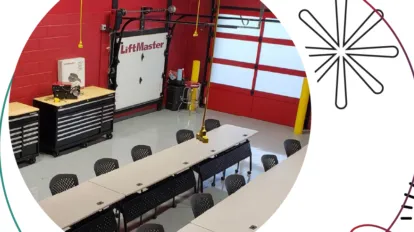
Back to School with the LiftMaster Training Academy
ONETEAM MVP - Greatest Hits
How myQ Community 30-Day Video Storage Protects Properties and Residents in Florida
Contact Us
If you're a member of the media and you'd like to get in touch with our Communications team, please fill out the form below.

