Remembering Colin Willmott
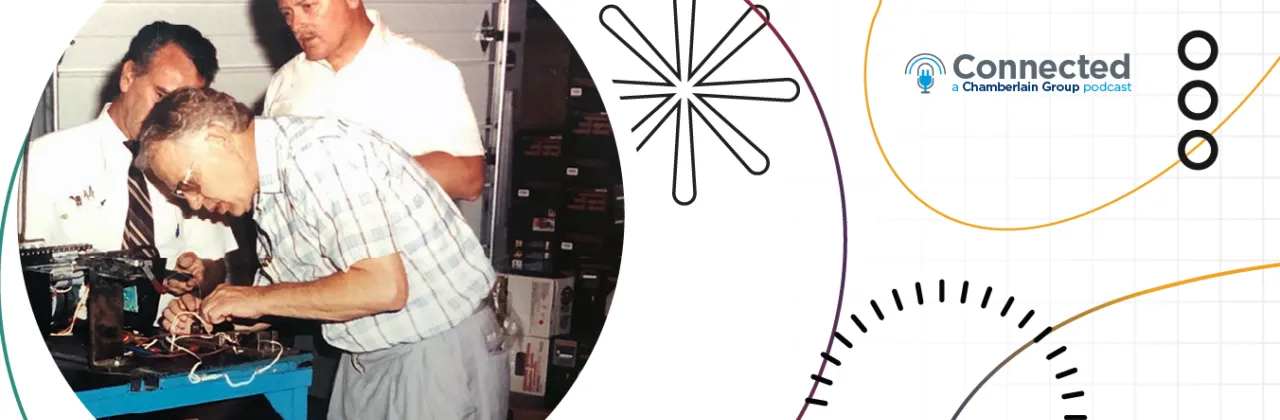
This month we are remembering the life and career of Colin Willmott, who passed away in December of 2024 at the age of 89. Colin worked at Chamberlain Group from 1961 to 2020, holding over 100 patents and earning himself the industry-wide title of "Mr. GDO." Colin dedicated his career to making access control smarter, safer, and more secure. Listen to both friends and family tell Colin's story.
Transcript
Colin Uthe:
I want to do something fun real quick. I hope it's fun at least.
Rob Keller:
We'll see.
Colin Uthe:
So I'm going to read a couple milestones, and I want you to tell me, to the best of your recollection, if Colin was involved in these milestones here. 1987, the first patent ever is obtained by Chamberlain Group for a receiver system. Garage door openers no longer need DIP switches to set radio codes.
Rob Keller:
Oh, yeah, that was totally his baby. He wasn't the only guy here, right, but it was totally his baby.
Colin Uthe:
Definitely got his hands on it, right?
Rob Keller:
Yeah. BillionCode, is what came of that.
Colin Uthe:
1989, the industry's first wireless keyless entry system is introduced by Chamberlain Group.
Rob Keller:
He was Director of Engineering, I think at the time, so hard to believe he wasn't involved.
Colin Uthe:
Yep. Yep. This one's a given because there's a photo of him on the milestone, but 1993 is when US Congress amended the Federal Act requiring residential GDOs to be sold with safety sensors.
Rob Keller:
Right.
Colin Uthe:
Which I know was-
Rob Keller:
He considers that one of his greatest achievements.
Colin Uthe:
I think most people would consider that his greatest achievement. Yeah, definitely. 2001, Chamberlain Group introduces its first line of DC motor garage door openers, resulting in more efficient power consumption, quieter operation.
Rob Keller:
DC GDOs were more popular in Europe, and he brought that back.
Colin Uthe:
Oh, okay.
Rob Keller:
So we were doing it for Europe. We were making our own for Europe, and then we pushed into the US, and now we're almost exclusively DC GDOs.
Colin Uthe:
How about this one? 2006, CG expands to Australia and New Zealand with the acquisition of Merlin and Grifco?
Rob Keller:
Yeah, he was absolutely involved. In fact, Colin, myself, and a guy named Mark Karasek were the first people in Auckland after the deal was struck, and we were working with the owner in a little office in Auckland, and we worked with him on where we were going with the next generation of products because they had some challenges ahead of him. So Colin was there.
Colin Uthe:
He was there. He was there.
Rob Keller:
Yeah, I was too.
Colin Uthe:
What happened, what was his involvement when myQ, you started to come to fruition?
Rob Keller:
That's a good question. Well, he was certainly around, and he spent a lot of time troubleshooting or telling me how stuff didn't work, but Colin was not super involved with the computer, the server, the middleware side of it, and then the app side of it, but certainly he was involved with idea generation.
Colin Uthe:
Welcome to Connected, a podcast about the operations and the people that make up Chamberlain Group. Thank you for tuning into our first episode of 2025. This show has been produced by yours truly for over two years now, and it's one of my favorite things that I get to make for our company, so thank you for continuing to listen.
This month's episode is going to sound a little different from episodes in recent past. We're remembering the life and career of the person who has possibly contributed more to Chamberlain Group than anyone else, Colin Willmott, who passed away in December of 2024 at the age of 89. Colin worked at Chamberlain Group for 59 years and held over 100 patents before retiring in 2020.
In this episode, you're going to hear from a couple of colleagues, Rob Keller and Jeremy Jenkins, Craig Duchossois of the Duchossois Group, former owners of Chamberlain Group, along with his son, Colin (not junior, they have different middle names), his daughter, Christine, and his wife of 49 years, Babette.
Before achieving legendary status in our industry, Colin came from very humble beginnings. He was born in London in 1935, surviving the German Blitz of World War II, and when he was 12, moved with his family to a small town in Alberta, Canada. He later joined the Royal Canadian Air Force working on radar technology in the Arctic Circle during the Cold War. And shortly after that, in 1959, he found himself in Chicago where he would call his home base for the rest of his life. His son recalled a few of the first jobs that Colin worked leading up to what would be his lifelong career.
Colin Brian Willmott:
I think he used to shine shoes. I think his very first job was setting bowling pins after they were knocked down at a bowling alley in Waterton Lakes. He worked in a ranch, did a lot of odds and end jobs. You could say he probably worked from probably like 1945 to like 2020.
Colin Uthe:
Why did he end up moving to Chicago of all places?
Colin Brian Willmott:
He moved there with, well, I think shortly after his brother did in 1959. I don't quite remember, but his brother may have moved there because he met a girl who he's married to, still married to. Him and his brother basically went there together.
Colin Uthe:
I see. Okay. That makes a lot of sense then. And then, yeah, I saw 1959 move to Chicago, and then very shortly after, a couple years, started at what was Permapower, I believe, at the time, which then eventually became Chamberlain Group proper. Do you know why he picked the job?
Colin Brian Willmott:
I believe he worked first at Motorola in, I think, the early sixties. He basically received his technical training at the Air Force. My understanding is he didn't have a high school degree or a college degree, so this is really back in the days where he had some formal training in terms of I think night schooling here and there at IIT, but beyond that, it was all on-the-job training.
Colin Uthe:
About 10 years after settling into his new job in his new city is when Colin met his would-be wife.
Colin Brian Willmott:
Were you aware that, I think this is true, they met at work?
Babette Willmott:
That's where we met.
Colin Uthe:
That's where you met. When did you start working? Was it Permapower or was it Chamberlain Group?
Babette Willmott:
It was Permapower. I must've been working there in '72.
Christine Mowbray:
I just know apparently it was a casual Friday, and my mom walked by his office wearing a skirt.
Babette Willmott:
Well, I didn't know anything about him really. Just to see him, I knew who he was, and they said, "Wait, maybe you should talk to him and say..."
Colin Uthe:
Can't hurt, right?
Babette Willmott:
That's how I kind of, then I kept walking by his office and stuff...
Christine Mowbray:
And so he was like, "Well, can I have you type up something for me?" My dad had her type something up and then when she brought it back, he asked her out to McDonald's.
Babette Willmott:
Well, it was for lunch now. And then, I guess eventually, then we went out to, there was a place up in Mundelein then: Daryl Street Inn. Started dating...
Colin Uthe:
And the rest was history, huh?
Babette Willmott:
Yeah. That's how it started.
Colin Uthe:
About 20 years after that is when Chamberlain Group started to expand its operation, and Colin expanded his role to travel more and support the international businesses that were being bought up.
Rob Keller:
I met Colin in the late '90s. I was relatively new here, and he was actually in Germany. He'd moved his family over there to support a acquisition we made. I think it was called Wekla, and that became the Chamberlain Germany office.
Babette Willmott:
Germany was a lot of fun. Yeah, we liked it there. All the good food, and you can go traveling, and we saw a lot of Europe while we were there.
Colin Brian Willmott:
Closest international school was in Luxembourg. My dad was like, "No, no, no, we're not going to do that. You're going to go to the local school." And I remember just sitting in school for weeks on end, probably the third grade, not taking a single thing in until eventually, I think, one day you start learning to some degree. My sister, we were the translators for the family as we would go around on all these trips.
Christine Mowbray:
My mom was such a history buff because that was her degree was in history. We traveled so much over there.
Colin Uthe:
Well, there's nothing to do in Europe for history stuff, so I don't know what you guys would've done there.
Christine Mowbray:
I know. So boring. But we went to castles. I still remember the sound our car made over the brick roads.
Colin Uthe:
What kind of car did you have there?
Christine Mowbray:
We had a Pontiac, a Pontiac Bonneville.
Colin Uthe:
Isn't a Pontiac an American car?
Christine Mowbray:
Yeah, we shipped it from Europe, from US too.
Colin Uthe:
Germans make the best cars. I don't know why he didn't sell the car. He must've loved that Pontiac then.
Christine Mowbray:
We drove our American cars.
Colin Brian Willmott:
My dad had a Dodge Stealth, 1992 Electric Blue. Everybody in the village just loved that, and then we also had a Pontiac Bonneville, which was like a giant boat and driving that in small towns in Europe, and a lot of times we even took that thing to Italy. Driving the small little roads was not a good idea.
Colin Uthe:
No.
Colin Brian Willmott:
We were kind of a novelty.
Christine Mowbray:
I have a funny memory about the license plates are longer instead of fat like ours. You had to hammer it in place.
Colin Uthe:
Going to great lengths for the American car in the foreign land. That's funny.
After that time in Germany, I heard that you guys just came right back to the same house. Is that the one you're sitting in right now?
Babette Willmott:
That's right.
Colin Uthe:
It is? Yeah. How long have you had the house for?
Babette Willmott:
Well, must have moved here in '77, '78. '77 I think.
Jeremy Jenkins:
He was running our engineering teams over there for a while and working on international products. Colin was instrumental in helping set that up and also making sure that things were running smoothly. He would go to Asian suppliers on that side of the world if we had an issue with the US design as well.
Babette Willmott:
Well, then he was there for a while. He was going to China a lot. Oh, he spent, I forget how many days it was in that one hotel, 200 days or something.
Colin Uthe:
Did he have a favorite hotel?
Babette Willmott:
Yeah. I forget the name of it now, but it's where we stayed when we went to visit too.
Jeremy Jenkins:
He was supporting a little bit of everything from our contract manufacturers to our supply chain he would get involved in. And then when he would come back to the US, he would always bring his best practices. He'd been designing the garage openers for many years.
Rob Keller:
Colin traveled extensively. In fact, just coming in here, I was talking to John Lee, and we're saying, "Well, what are you doing here?" And said, "I'm talking about Colin." He said, "Oh, he took me on our first trip to China." There's probably 50 people can say Colin took him on their first trip to X or Y or Z, but I went to him with my first time in Malaysia. I'm sure Colin was there, so we had a factory in Malaysia. My first time in China. I think I met Colin there, but he gave me detailed instructions on how to get to where I needed to be, and there's so many people that have that same story, and he was a great traveler.
Jeremy Jenkins:
We had a lot of working memories and working on designs together, but the best memories were traveling together. When we would go into China and do our supplier rounds and visit and do a little supplier development, get to know the suppliers a little bit better. Always showed you the spots, always told you the tricks, and I'll tell you, he was probably the fastest running around the trade shows and energetic. He would go, you'd look at-
Colin Uthe:
He's got people to see.
Jeremy Jenkins:
Yeah, that's right. He knew everybody, and then we'd walk maybe a couple of miles just around a trade show, and he never slowed him down even when he was working for us when he was in his seventies and eighties.
Colin Uthe:
What should people know about Colin Willmott?
Rob Keller:
First and foremost, all about quality. It drove him nuts if something didn't work right. We used to plop down in my office and hold court.
Jeremy Jenkins:
He often liked to be called the Director of Havoc, is what I remember of him.
Colin Uthe:
Director of Havoc?
Jeremy Jenkins:
Yes. He was our international liaison for many years, and he would travel around, and he was still part of our design interview committee, and back then Rob Keller was running the design interview committee, and he would sit on the committee, and he'd come in and show from a long trip, and he would review people's designs, be very candid, give him feedback and coaching, but he always called himself as kind of a Director of Havoc.
Babette Willmott:
He always made sure everything was done right. I heard from some of the younger engineers, they said when they were there, it was like, "Oh, you didn't like it when he came barging in at your door." He was going to complain about something or tell them to get this fixed.
Colin Uthe:
Yeah, because you're going to do it right if he's looking over your shoulder. Yeah.
Colin Brian Willmott:
We would go into the office when I was like 10, and from my understanding, he just would just roam the hallways. That was his job, just walking around all the time, see how things were going. People would bounce ideas off him. It was my understanding. I've also went a couple times with him to China, to the factories there, and I saw that whole organization, and again, just saying he's just walking around. He says sometimes he could probably get frustrated, but I think in general, most people respected him, and he really had a great time at work.
Colin Uthe:
Quality was his main thing too. If somebody's getting frustrated with him, it's because he knows they can do a better job on something.
Colin Brian Willmott:
Yeah, I mean, that's the whole thing about the safety stuff. He was really involved and took that to heart.
Craig Duchossois:
He basically was an industry icon. Not only was he technically an out of the box thinker, but he was dedicated to values that our family business holds in esteem, and that was safety.
Colin Uthe:
While Colin was credited a lot for his uncompromising standards for quality, what he's most well known for are the standards for safety that he pioneered at a national level in the early '90s. Listeners from my generation and later may not think about it, but not too long ago, that safety sensor towards the bottom of your garage door used to be non-existent and then it used to be optional.
Rob Keller:
Prior to having eyes installed around six inches from the ground, there were serious injuries and deaths that came about because the force-sensing systems weren't perfect.
Craig Duchossois:
As a result of that, we said, "This is totally unacceptable." We took an industry leadership position to come up with redundancy so that if something came in the way of a closing door, the door would reverse.
Rob Keller:
Due to some incidents that happened in, I believe in Minnesota, it was written into law, and certainly Chamberlain supported that because the Chamberlain and Colin believed that it was the right thing to do.
Colin Uthe:
Didn't he release the patent too?
Rob Keller:
Yeah, yeah, yeah. If you're going to make something like that a requirement, you can't be the only holder of the patent, right? It was the right thing to do for sure.
Colin Uthe:
It's the right thing to do.
Rob Keller:
Yeah, and Colin always did the right thing.
Colin Uthe:
That's really the biggest detail to me that sticks out is not only did he play a huge part in saving lives after that was instated, but doing the right thing and making sure that everybody, if they can, who makes garage door openers to follow suit.
Rob Keller:
Yeah, absolutely. I don't believe there's been a fatality or a serious injury on an installation with properly working eyes since then, so that's 30 plus years of substantially increased safety.
Craig Duchossois:
That moved him to a position of industry leadership, icon, respect, and given the fact that he was at the forefront, Mr. Garage Door.
Colin Brian Willmott:
The thing about, and maybe you've experienced this as well with your wife, does your wife really know what you do? Does she?
Colin Uthe:
No, not quite. I can't quite explain her job, and she can't quite explain mine, but we try.
Colin Brian Willmott:
Because again, even as part of his family, you're just kind of sitting there and on the couch next to you is this guy who has a lot of accomplishments, and you have no idea.
Christine Mowbray:
I do agree that he thought his laser beams were probably the most important thing he's done because I think he recognized that he saved kids' lives, but he was a really good dad.
Colin Uthe:
Yeah, he was.
Christine Mowbray:
I wish I had more time, and I wish my daughter had more time because he was so good with my kids. Yeah, he was such a good family man, even though he was really into work, and he was really good at work, he always came home to us, and he made us a priority. He wasn't on his phone. He wasn't on his computer when he came home. He was home when he came home, and we always had family dinners, and that is something I'm very adamant with my kids too, is when dad comes home, we have dinner together, and I think that made a really great family life and upbringing, and it just made me feel important, and he asked about my days, and so I never asked about his days because I was a kid.
Colin Uthe:
It's okay. It's not your job.
Colin Brian Willmott:
He was somebody who would go to a lot of our games, our sports games, which I know can be sometimes 4:30 after work. That'd be hard to make, but he would often be at those games.
Colin Uthe:
It's a bigger commitment than people think.
Christine Mowbray:
He really was a family man. His kids, his family were the most important to him, I think.
Colin Uthe:
I love that you said that because your dad is probably the most significant person in our niche, but very important industry, and beyond all that responsibility, he cared about you guys the most.
Christine Mowbray:
Yeah.
Colin Uthe:
What should people know about Colin Willmott?
Babette Willmott:
Well, he was honest, stuck to his word. Whatever he said was you could believe it and trust it, and he was a hard worker. At home here too, he did all the repairs unless it was something really major.
Colin Uthe:
What drew the line for repairs? I'm kind of the same way. I always want to try. If I'm not going to hurt someone, I'm going to try it out.
Babette Willmott:
Well, the first air conditioner he put in here himself, save money. He was always watching to save some money, but then after that one crapped out after 10, 12 years or whatever, then he let somebody else do it then and he put new windows in the house.
Colin Uthe:
He's a carpenter. I didn't know that
Babette Willmott:
He's the jack of all trades.
Colin Uthe:
I thought the tinkering stopped with the mechanical stuff. I didn't know it went all the way into the woodworking and the house stuff too.
Babette Willmott:
And then we always had a garden, vegetables anyway. He didn't do much with the flowers or anything.
Colin Uthe:
That's a man gardener. It's got to be practical. It's always got to be practical. Yeah. What did you guys grow in the garden?
Babette Willmott:
Oh, about anything.
Colin Uthe:
Yeah. Didn't even have to go to the grocery store.
Babette Willmott:
No.
Christine Mowbray:
I would say perseverance. I think you can be rewarded in life with perseverance and hard work and not just saying, "Oh, poor me." Even though he was never able to truly finish college, he worked so hard in his field to know everything that I think he ended up being quite successful in Chamberlain.
Craig Duchossois:
Unassuming, wonderfully humble, always had a smile, always willing to deal with tough questions from ownership.
Jeremy Jenkins:
He was passionate about the industry, about the people. He cared a lot about everybody around him and the product, and he was loyal to the company. He works for us for like 55 plus years. It's unbelievable. Like the loyalty he had to the Duchossois family and to Chamberlain. That's something that everybody can learn from Colin.
Colin Brian Willmott:
Maybe the most important I think is he told me, "I'm not better than anybody else, and nobody's better than me." It's this humbleness to him because again, my dad, he grew up from very, very, very humble beginnings, an immigrant in Canada when he was a kid, and I think that kind of stayed within the entire time.
Rob Keller:
He never stopped learning. He never accepted poor quality. He was true man of the world and a man of science. I miss Colin already.
Craig Duchossois:
I sought his advice from time to time on a one-on-one basis. "Are you sure this is the right thing to do? What are the advantages? What are the disadvantages? Is it consistent with our dedication to safety? Have you looked at other opportunities or different approaches?" and it was sort of a validation. I didn't mean to bypass the engineering department, but sometimes you just need to have someone you know, trust, and respect, validate what was presented to the ownership. He was my man.
Babette Willmott:
He had a good disposition most of the time. He would have his moments.
Colin Uthe:
Yeah, don't we all?
Babette Willmott:
But he just was a go-getter and just a good guy.
Colin Uthe:
Yeah, he was. I'm sorry for your loss, Babette, and thank you so much for spending some time with me today. I really, really appreciate it.
Colin Brian Willmott:
And there's one thing that, again, we can piece together at some point here, but he got this watch in 1971. It was his ten-year work anniversary with Chamberlain/Permapower, so it says in the back, Permapower-Chamberlain, 1961 to 1971.
Colin Uthe:
Are you kidding? Wow.
Colin Brian Willmott:
It's a Seiko watch. It's not a very expensive watch, but it still ticks.
Colin Uthe:
No, yeah, still ticks. That's really, really, really cool.
Part of my job here is to record and highlight significant moments in the company's history, and listening to all these people speak about Colin, I quickly realized that there wasn't a milestone that occurred during his time here that he wasn't involved with in some way. Beyond that, his values of quality and safety resonate through the culture of every building he's set foot in, and every product that he touched. He is and will remain the largest single point of influence to Chamberlain Group.
I'm going to leave you with a quote from Colin when he was interviewed by DASMA shortly before retiring in 2020. When asked, "What do you consider the most important work rules to live by?" He said, "Everything is about intent and doing the right thing for our customers. I did not always see eye to eye with other departments on design, cost, and the direction of products, but we always agreed when it came to customer satisfaction and especially safety. Work should always be motivated by doing the right thing."
Thank you for listening, and special thanks to all my guests who sat down and shared some special memories about Colin: Rob Keller, Jeremy Jenkins, Craig Duchossois, Colin Brian Willmott, Christine Mowbray and Babette Willmott.
This episode was written, recorded, and edited by me, Colin Uthe. Our producer is Jim Kozyra. Our music was provided by soundstripe.com.
Related Insights
Matt Neff On The 5 Things You Need To Know To Create a Successful App, SaaS or Software Business
From Curb To Couch: Multi-Family Access Solutions with myQ Community
Code & Cadence with Jason Givens
Contact Us
If you're a member of the media and you'd like to get in touch with our Communications team, please fill out the form below.

