Unlocking the Power SmartSecure with the myQ Smart Outdoor Camera
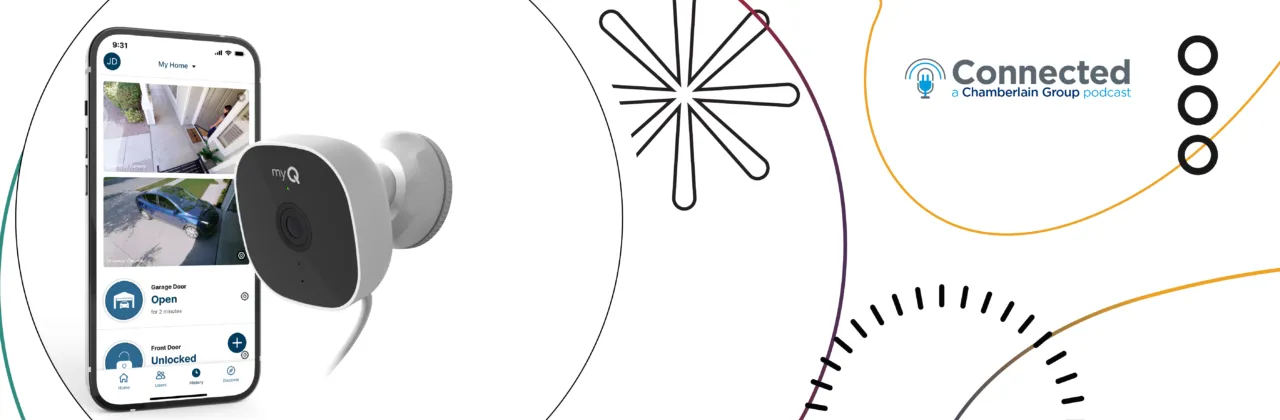
Join Chris Selle (Director of Product for Residential Subscriptions & Services) as he discusses his role and responsibilities. Later, with insights from Ben Hunt (Computer Vision Engineer), they delve into the development of Chamberlain Group's latest AI-driven security solution, which offers much more than just notifications.
Transcript
Colin Uthe:
Welcome to Connected a podcast about the operations and the people that make up Chamberlain Group. Last week, Chamberlain Group launched the newest product in our myQ Intelligent access ecosystem, the smart outdoor camera. While this new outdoor camera is impressive on its own, its capabilities are elevated to new heights when paired with other myQ products like our smart garage door openers and locks, as well as the latest feature of our video monitoring service called Smart Secure, which is somehow cooler than it already sounds.
With me this month to discuss these new products is Chris Selle with some help from Ben Hunt later on.
Chris Selle:
My name is Chris Selle, I'm the director of product for our residential subscriptions and services.
Colin Uthe:
Being the director of product, I'm sure that you are pretty familiar with just about every single angle of what you're selling. So tell me about that.
Chris Selle:
So my day-to-day is really working across a number of people in teams. It varies very often. So one day it could be working with the hardware teams and the business unit to really understand what are the big initiatives that we have coming up for the year in terms of new hardware programs? And how does that affect our ecosystem? And then we'll kind of go into the details of what's in that hardware, what is the experience that we're trying to deliver, how does software augment that experience.
Colin Uthe:
Grand strategy of it.
Chris Selle:
And then working with the software teams to think about how we bring that to life. And frankly, really kind of determine what is the best thing for our customers so that we're working on the right things. And that's because especially through looking across our video services, our automotive services, delivery services, plus all the hardware that we want to build that enables those services, there are always more things that we would like to do than what we have time and/or capability to do.
Colin Uthe:
So I'm sure you work with a lot of other business units to really understand the person that you're selling to as well, understanding the customer.
Chris Selle:
Yeah, absolutely. So there's a part of just one of the benefits I have is I get to be a customer. I have a dual bay garage, so I have two Chamberlain garage door openers, both of which were installed when we were launching those new product lines. So I was actively in the alpha testing for that
Colin Uthe:
First line of defense is seeing would you buy it? And what you're getting out of it.
Chris Selle:
Yes. And I initially joined Chamberlain as the product manager for our video services. So when someone buys one of our garage door openers with a camera or they buy a smart garage camera now, a video keypad soon, a outdoor camera.
Colin Uthe:
And that was a kick like five years ago that we started getting really into video.
Chris Selle:
Yes.
Colin Uthe:
So you've been here for how long?
Chris Selle:
Three and a half years.
Colin Uthe:
Three and a half years. So you started with video, and then when did you make the move to director of product?
Chris Selle:
That would've been January of last year. 2023.
Colin Uthe:
Okay. So you're pretty much settled into that role, I would say.
Chris Selle:
Yeah. Most of my focus is still going to be, a huge amount of it's going to be on video just given the opportunity for our business, the opportunity in terms of what we can do in the myQ application. And that's also because we have really strong teams in terms of our automotive business unit that are really spending a lot of time with their customers and being more of a thought leader on terms of our automotive services.
And then we have our director of our delivery and partnership services, and he has a team. So most of my collaboration where I'm more actively influencing what it is we're building and when we're going to be doing it is on the video and still a little bit to those other functions. And my biggest objective for auto and delivery is just making sure that we have the right team and the right processes to make sure that we're connecting the dots. We don't want to step on each other's toes and I want to make sure the team can be as successful as possible.
Colin Uthe:
While getting also to focus on the fun stuff and the cool stuff, it sounds like too.
Chris Selle:
Yeah, we build a lot of cool stuff.
Colin Uthe:
Well, speaking of cool stuff, why don't we run through a base suite of products that we offer to our residential customer?
Chris Selle:
Sure. Our core is the garage door opener. That's where we've been in business for decades.
Colin Uthe:
And where we will continue to be.
Chris Selle:
Yes. But as we want to make access simple, we've had locks with partnership with Yale, and we want to make sure that we're covering the access points of the home. So we have locks, we have garage door openers, we have cameras that can go inside your home. We have a camera inside the garage. We also recently completely innovated on the keypad outside the garage, which has been the same for decades. So the video keypad, which we launched last year was the first major innovation on that particular access point, which has delivered a tremendous amount of value.
It's not necessarily a piece of hardware, but the work that we've been doing on the automotive business is absolutely part of it because by engaging with Tesla, Honda, Acura, now Nissan and Infinity and others, we're bringing myQ into those vehicles so that they can interact with the ecosystem and deliver new experiences that you haven't been able to do before. Very highly precise and near magical, as someone's pulling into a driveway, the door opens. And with such a level of consistency and reliability, it's changing behavior. It's not just novel anymore. Then we're also going to be launching very soon here an outdoor camera.
Colin Uthe:
I would like you to tie that in with, tell me about the services that go along with these products that we offer.
Chris Selle:
So let's take a homeowner for example. We work with our customer research teams to deeply understand our homeowners. And so we take a homeowner and a family, say it's like two parents, two kids, they have a house with an attached garage. They may have one of our garage door openers, they may have our video keypad or not. And they likely have another camera in the garage or maybe an outdoor camera. So with the garage door opener, they're already eligible to have Amazon or Walmart deliver for free into their garage. And so that provides a benefit because they don't have to worry about the package sitting on their front porch, whether it's something as simple as food or cards that they don't want to get wet because it could be inclement weather, or if they're worried about porch piracy in their neighborhood, it can be delivered securely into their garage.
Colin Uthe:
And that's just bundled in with Prime. If they have Prime, they have that service.
Chris Selle:
Yes, exactly. That's totally a free benefit for the customer just by being connected to myQ and with Amazon Prime. If they have a camera, then they can actually take the capabilities one step further. So to start there is cloud storage, so our cameras can be recording and then you can store footage to review later. But we've really started putting in more capabilities into our cloud and into the camera itself so that we can communicate more meaningful context to our customers
Colin Uthe:
If you have motion being detected through an eight-hour day.
Chris Selle:
It's a lot of stuff.
Colin Uthe:
It's a lot of stuff. Right.
Chris Selle:
And that was one of the things that I'm sure you could relate to that our customers already relate to is with more and more things that are consuming our time, our attention span is going down. That's well researched, well documented. So as you think about a camera that can detect something. Well, it can really quickly become searching for a needle in the haystack when you're detecting nearly everything. And so our customers have already been really clear that what really matters is not just detecting this random piece of movement or a tree blowing in the wind, but they want to see and know about the more meaningful moments, the meaningful interactions, whether it's their kids coming home so they know they got home safe at 2:33 P.M. after school. Or it's some random event. It could be is there something that happened at eight P.M. they would want to have brought to their attention.
Colin Uthe:
Like outside the range of normal events.
Chris Selle:
Yes.
Colin Uthe:
I have a smart doorbell. I have a video doorbell that is very close to our main road, and I just have a lot of difficulty finding the sweet spot between too much information and not enough.
Chris Selle:
Absolutely. So there's stuff that we've implemented that have helped make that a little bit simpler. So whether it's person detection or face detection, you can already prioritize for if any person is walking by. Or, like I said, if you live in the eligible states, you have to consent and then you have to go through an active way to add a face. You can also enable face detection. You're really going to benefit more from your family on that one because of that consent flow. We're not going to be capturing faces just as someone's walking by.
Colin Uthe:
Are you saying I can run out the mailman and be like, "Hey, do you mind if you consent to when you show up to my house?"
Chris Selle:
You could ask him, but at least he knows you're going to ask him because we're not going to be gathering it without you getting their permission and without us getting their consent.
Colin Uthe:
For sure.
Chris Selle:
But there's already that, well, it could be any form of motion, whether it's a tree or a shadow, but it could be a person or it could be one of your family members faces or someone close to your family. We've also added an element of "where" earlier this year. So in your example of the front doorbell, you can actually set a zone to prioritize, "I only want to detect motion on my sidewalk, or maybe even not the sidewalk, only the approach to my home." And then anything outside of that zone we don't notify you of. So that allows you to set sort of prioritization of what you would like to detect.
But we want to take it a step further. So as you think about someone with an outdoor camera, maybe they have another camera at the front door or another one by the keypad at the garage, and maybe they have a connected lock, maybe they have a connected garage door opener. I'll walk you through a simple use case, which is one of our kids coming home from school. A camera might detect them as they get off the bus, and then another camera might detect them as they're walking up the driveway. And then the door or the garage is going to say, "Hey, I've been open because Jimmy has come home from school," and then they go in the garage, they shut the garage again.
And so you end up with all of these little transactions that happen along the way.
Colin Uthe:
In the same routine.
Chris Selle:
And suddenly it's like my mother-in-law is on Instagram liking all of my story posts because my phone is blowing up with just like 1, 2, 3, 4, 5, and at the end of the day it's just Jimmy came home.
Colin Uthe:
And you become numb to that too.
Chris Selle:
You do.
Colin Uthe:
You stop caring about those notifications because, one, they come in at the same exact time they're supposed to and there's too many of them.
Chris Selle:
Yes. So we want to make it easier for users and customers to really get the most insightful notification, to be the one that's most valuable for them. It's not something that we have ways that we are trying to simplify with the prioritization of what's being detected, but we're trying to really think about how we can reduce the amount of notifications to focus on really what is the most meaningful and most contextual notification.
Colin Uthe:
I'm getting the vibe that you're sort of teasing at some of the new stuff. But yeah, let's talk about that in detail. So with the release of our outdoor camera, which is scheduled for the end of this month, I want to say.
Chris Selle:
Yes.
Colin Uthe:
So that's beating into October. We're going to be moving forward with our outdoor camera and a set of new capabilities. So tell me about those.
Chris Selle:
Yeah, so the outdoor camera is a new vantage point. So the new vantage point allows us to solve for new use cases, and one of my favorites is one that we're solving with a feature that we're calling SmartSecure. Now, one of the things that myQ with the fact that we have the garage door opener can do is that we can open and shut your garage door for you. And so with a camera that can already detect if there are a person in its field of view and the ability to shut the garage, we really want to solve a use case, which is like, Hey, as a user, if you wanted to set a schedule where you wouldn't expect anyone to be on your front lawn or in your driveway between let's say the hours of 11:00 PM and five in the morning and the camera detects a person, we'll send a signal to make sure your garage door is shut. And if it's not, we'll shut it for you.
Colin Uthe:
Oh, very cool.
Chris Selle:
Yeah, so we're calling it SmartSecure. Before where our cameras are sending meaningful notifications or they're capturing meaningful content. Now it's taking an action on the user's behalf where it's an automation that focused on increasing peace of mind and enhancing the sense of security for homeowners.
Colin Uthe:
I find it really interesting that we're focusing on the negative space of notification meaningfulness rather than trying to report incessantly on when things are supposed to happen. We're reporting on when things are not supposed to happen or anomalies in our schedule, that sort of thing.
Chris Selle:
So as we talked our customers, we really kind of found a couple key themes that came out in terms of their wants and needs, and one of them is a sense of security. They get greater peace of mind and a greater sense of security if they have more control over their home, and they can also have greater awareness of what's going on around their home. And outside of that, it's also convenience. And so we're looking at what does that mean? Well, it's like I want to know about the abnormal. What do I not expect to happen and how can I be more aware of what didn't happen, and not lose that in a forest of other normal everyday events that might completely bombard either the notifications or my event streaming history.
One of the things that having been focused on smart home and video particularly for the last three and a half years, cameras can deter but they can't actually stop someone.they might capture, you might be able to see it happen after the event, and that might allow someone to follow up potentially, but from a security standpoint, the camera can't.
Colin Uthe:
All it can do is notify.
Chris Selle:
Yeah, they can't do something for you. And so that's what got us really excited was SmartSecure, and the fact that we can tie what the camera sees to the garage. So this is actually something where the camera can initiate an action for the user itself.
Colin Uthe:
What sort of relationship do you have with the team that are developing these capabilities?
Chris Selle:
Oh, direct. It's a very direct. So my team, the way my team is structured, I have product managers who work for me and each of them has a squad of engineers who are basically bringing these experiences to life. And so whether it's SmartSecure or some other features that we also have coming out with the outdoor camera, which is a vehicle and animal detection, we're also working with our engineering team and advanced engineering to bring these experiences to our customers.
Ben Hunt:
I am Ben Hunt. I'm a computer vision engineer at Chamberlain Group, and I've been working on the SmartSecure feature for our outdoor camera.
Colin Uthe:
You have been a guest on this podcast before. Unfortunately for you, you are my friend, so I call you when I need some talent. So thank you for stepping in the scene again.
Ben Hunt:
Anytime.
Colin Uthe:
I appreciate it. The last time that I did talk to you, we spoke about your work on the AI recognition of existing garage door openers and people's space and how they can get connected with the myQ environment.
Ben Hunt:
Yes.
Colin Uthe:
How's that going so far?
Ben Hunt:
It's going great. We've put a lot of users online using the myQ system. The system is still up. We've made some improvements to it, so it works better than it did before, and we're going to continue looking at it to see which ways we can make it better.
Colin Uthe:
You played a role in the SmartSecure solution that we were rolling out. What did you do specifically on that project?
Ben Hunt:
A lot of it was ideating around how we could potentially reuse some of the AI features that we already had in a much more intelligent way. More specifically the unique position that Chamberlain Group and our products have within that space. It was trying to identify what could we use to differentiate ourselves, where do we uniquely sit within that space? And I think with the products that we have, we're one of few companies that could actually do something like this.
Colin Uthe:
And have the capability to automate as well as report.
Ben Hunt:
Yeah.
Colin Uthe:
Very cool. You had mentioned that this is a matter of finding new and fresh use cases to build on top of an AI platform that already exists within Chamberlain Group. How does it feel working on a project like this as opposed to a more primitive "get AI off the ground" type scenario earlier in your career?
Ben Hunt:
Oh, yeah. It's interesting because it's a little bit more like a traditional software development process. And so I'll contrast that with what new AI features generally look like, because whenever we have an idea for something and we don't already have some sort of machine learning solution for it, usually we start at determining what kind of data we need and then how do we ensure that it's learned what it needs to in order to perform that function.
And so the basic example that this uses is people detection, face recognition. And so in order to make that work, you need to collect a lot of examples of people, faces, how all of that looks to a camera, whereas building on top of this, it involves some creativity in how do you use the output of this system that's already been made?
And so there's not so much new data collection. You collect data for error cases and you use that to improve the system, but you're still developing new software features that are just using the output of those models in different ways. And so what it's able to do is interpret it in a new context, and the design work that needs to be done is understanding what that new context needs to be.
Colin Uthe:
Would you say, I mean, is it just you on the video team or is it multiple members of your team that have been contributing?
Ben Hunt:
No, it's been multiple members on the video team. And we've had a number of discussions of what could this do, what are other features that this could possibly perform in the future as well. And it's a big question of just making sure that we de-risk it and then it works really well for users. So we might have an awesome idea, but find that there's some technical limitations to it, and so we have to go back to the drawing board and redesign some things to make sure that it works as well as we want it to.
Colin Uthe:
Tell me more about the de-risking part. Because you don't want to roll this thing out to the world unless it works, for lack of better word.
Ben Hunt:
Right. Yeah. So we do a good amount of internal testing with alpha users, get some preliminary builds onto user's devices and make sure that they have access to some preliminary versions of these features and they can report back all of that information to us. And then we use that to make improvements to the current design. Maybe it involves some slight redesign to make things work better. But we're always looking at ways to not only improve the user experience, but then also take that feedback and improve the technology behind it. And so if we ever find that it's a limitation of the technology, then we try and go and gather more data, more information about how that works and improve those that way.
Colin Uthe:
Going on about a year at this point, you had said you were excited to talk about some video AI features that were not ready to debut yet. I was just wondering if this was maybe bundled into that maybe over a year at this point?
Ben Hunt:
We were talking about it back then. Yeah. I might've been thinking of a number of other things too, but this was definitely one of those.
Chris Selle:
I think what makes me really excited is on a couple different fronts, we're going to be introducing more hardware to our ecosystem, which really allows us to cover more places to monitor around the home as well as more access points. And we're also bringing more technology to get more specific on what is going on around the home. And it helps us solve for two sides of the equation, the what is going on, trigger, if you will, and the automation that we want to have on the back end. What action can we take on behalf of the user?
But because we're getting more involved with the number of things that we can monitor and control, it actually gets more complicated. And so to do it well, we're investing in technology that we really want to use artificial intelligence, whether it's computer or potentially generative AI, I can't talk too much about it, but we're exploring it, to think about how we can make it as simple and seamless as possible. If it's not reliable, if it's not simple, it will be novel and not transformative, and we want to be transformative in terms of making it easy and simple to set up and deliver meaningful value to our customers.
Colin Uthe:
I have one more question for you and then I'll wrap this up. As the first customer that you have to sell to being yourself, what would you say you get the most value from in our ecosystem?
Chris Selle:
Good question. I think right now where I get the most value is out of my video keypad. And so that's because I am one of those customers, I have a two and a half year old, and so this summer has been the summer of Avery, that's my daughter's name, where I got her balance bike. And so the first time we were going up and down the driveway on her balance bike, and at the end when she says, "I did it."
Colin Uthe:
You got that moment, didn't you?
Chris Selle:
I captured it. Captured that moment, favorited it, saved it. I haven't shared it with anyone in marketing.
Colin Uthe:
Not ready to fully exploit cherished memories of your family yet.
Chris Selle:
We'll, think about it.
Colin Uthe:
That's really cool that you got that though. And it's easy too. You didn't have to.
Chris Selle:
It's a simple one.
Colin Uthe:
It's just there.
Chris Selle:
It's a simple one. And now I'm excited for more stuff, but that was really sentimental and I really appreciated that.
Colin Uthe:
Well, that was unexpectedly emotional. Thanks for the teary-eyed podcast episode, Chris. Well, thank you again. I really appreciate you sitting down with me for a little bit and talking about latest and greatest in the video products up and coming and getting everybody excited for that sort of stuff.
Chris Selle:
Yeah, thanks for asking me. This is a ton of fun and happy to do it whenever.
Colin Uthe:
Thank you for listening. To learn more about our smart outdoor camera or SmartSecure visit myQ.com, and as always, tune in next month to hear more stories of how all of us at Chamberlain Group are connected. This episode was written, recorded, and edited by me, Colin Uthe, our producer is Jim Kozyra. Our music was provided by Soundstripe.com.
Related Insights
New Solutions for Multifamily Access Control
10 Million myQ Connections and Counting...
Controlling Your Real Front Door with the myQ Video Keypad
Contact Us
If you're a member of the media and you'd like to get in touch with our Communications team, please fill out the form below.

